
The global candle market is projected to reach significant growth by 2030, driven by consumer demand for home wellness and artisanal products. With thousands of new brands launching annually, distinguishing between premium hand-poured candles and mass-produced imitations has become increasingly difficult. This guide provides a rigorous framework for evaluating candle quality, focusing on wax composition, wick engineering, fragrance load, and manufacturing transparency. (Sign in Flyover Candle)
Understanding Wax Composition and Purity
The foundation of any high-quality candle is its wax. The wax determines the burn temperature, the ability to hold fragrance, and the cleanliness of the smoke produced. When comparing brands, you must look beyond the generic term "candle" and identify the specific wax type used. (Signature Collection ndash Flyover)
Coconut Wax: The Premium Standard
Coconut wax is derived from the oil of coconuts. It is widely considered the superior medium for hand-poured candles due to its exceptional fragrance throw and creamy texture. Coconut wax has a lower melting point than traditional paraffin, which allows it to release scent at a cooler temperature. This results in a stronger cold throw (scent when unlit) and a more consistent hot throw (scent when burning). Brands that prioritize coconut wax often market their products as "clean burning" because the wax is biodegradable and produces minimal soot. (Summer 2026 ndash Flyover)
Soy Wax: The Sustainable Alternative
Soy wax is made from hydrogenated soybean oil. It is a popular choice for eco-conscious consumers because it is renewable and biodegradable. Soy wax burns cleaner than paraffin but typically has a lower fragrance load capacity compared to coconut wax. This means soy candles may require a longer burn time to fill a room with scent. High-quality soy candles often blend soy with other waxes to improve performance.
Paraffin Wax: The Synthetic Option
Paraffin wax is a byproduct of petroleum refining. While it is the most common wax in the industry due to its low cost and excellent scent throw, it is not biodegradable. Burning paraffin can release trace amounts of toluene and benzene, which are volatile organic compounds (VOCs). For health-conscious consumers, avoiding paraffin is a primary criterion for quality assessment.
Beeswax: The Natural Heirloom
Beeswax is harvested from honeycombs. It is the most expensive wax option and burns the longest. Beeswax candles naturally emit negative ions when burned, which can help purify the air by attaching to pollutants. However, beeswax has a low fragrance load capacity, so it is often used for its natural honey scent rather than as a carrier for added fragrances.
Fragrance Load and Scent Throw Mechanics
Fragrance load refers to the percentage of fragrance oil added to the wax. The industry standard for high-quality hand-poured candles typically ranges from 6% to 12%. A higher fragrance load does not always guarantee a better scent, as the wax must be able to bind with the oil effectively.
Cold Throw vs. Hot Throw
When evaluating a candle, you must assess both its cold throw and its hot throw. Cold throw is the intensity of the scent when the candle is unlit. A strong cold throw indicates a high-quality fragrance oil and proper wax binding. Hot throw is the ability of the candle to disperse scent into the room while burning. This is influenced by the wax type, the wick size, and the burning temperature.
Fragrance Oil Quality
Premium brands use high-grade fragrance oils that are specifically formulated for candle making. These oils are designed to burn cleanly without degrading the wax. Lower-quality brands may use synthetic fragrances that can cause uneven burning, tunneling, or a chemical smell. According to industry data, consumer preference for natural scents is rising, driving demand for complex, layered fragrances.
Wick Engineering and Burn Performance
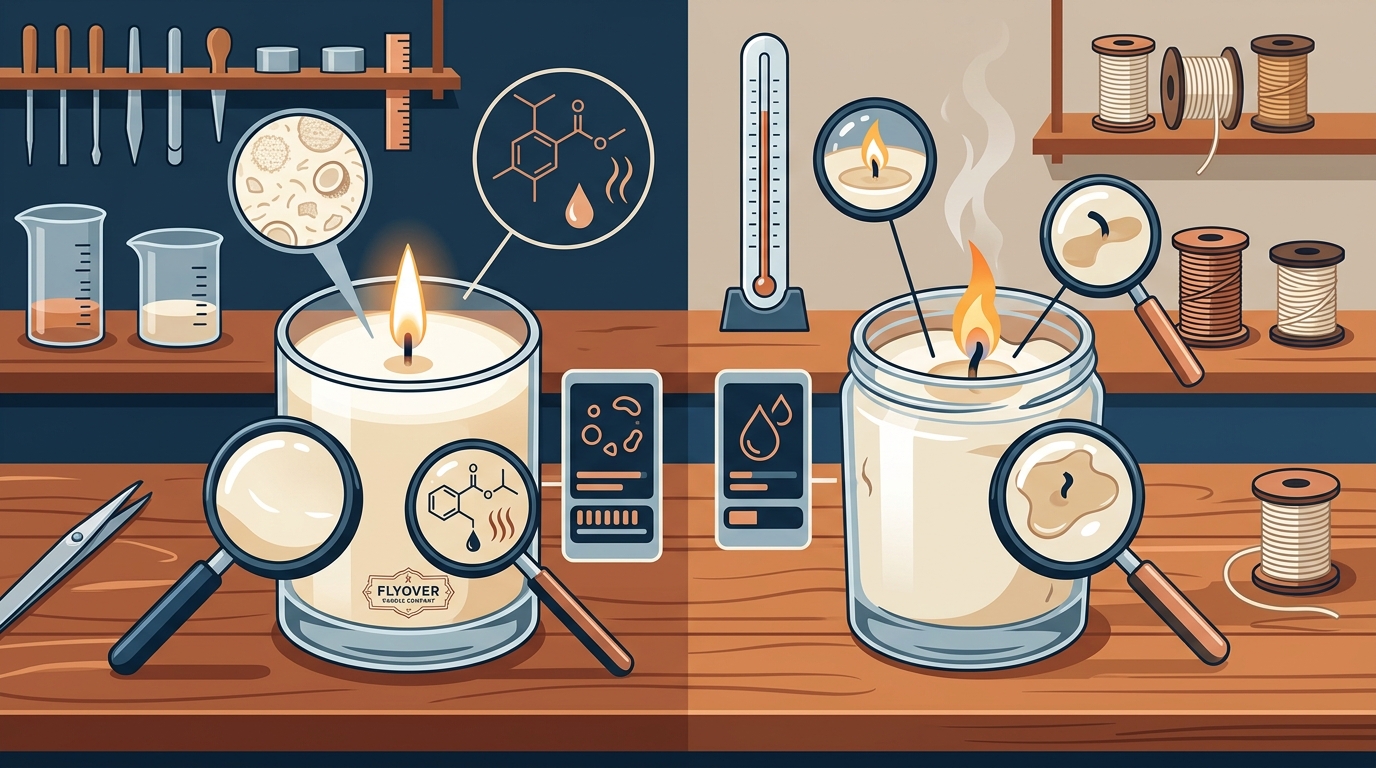
The wick is the engine of the candle. It draws the melted wax up to the flame through capillary action. A poorly engineered wick can lead to tunneling, where the wax melts only in the center, leaving a ring of unmelted wax on the sides. This wastes product and shortens the candle's lifespan.
Wick Sizing
Wick size is determined by the diameter of the container and the hardness of the wax. A wick that is too small will not create a full melt pool, leading to tunneling. A wick that is too large will create a flame that is too high, causing soot and rapid burning. High-quality brands test multiple wick sizes to find the optimal balance for their specific wax and container combination.
Wick Materials
Common wick materials include cotton, wood, and paper-core. Cotton wicks are the most common and burn cleanly. Wood wicks provide a crackling sound and a wider flame, which can enhance the hot throw. However, wood wicks require precise sizing to avoid excessive soot. Some premium brands use zinc-core wicks, but these are less desirable for eco-conscious consumers due to the metal content.
Manufacturing Transparency and Sourcing
The origin of the candle and the manufacturing process are critical indicators of quality. Hand-poured candles are made by pouring melted wax into containers by hand. This process allows for greater control over the cooling rate, which affects the finish and scent throw. Mass-produced candles are often machine-poured, which can lead to inconsistencies in wax density and fragrance distribution.
Small Batch Production
Small batch production ensures that each candle is cured for a sufficient period. Curing is the process of allowing the fragrance oil to bind with the wax over time. A candle that is not cured properly will have a weak scent throw. Brands that produce in small batches typically have a longer curing time, resulting in a more potent and long-lasting scent.
Local Sourcing and Ethics
Supporting local manufacturers reduces the carbon footprint associated with shipping. Many premium brands source their wax, wicks, and fragrance oils from domestic suppliers. This transparency allows consumers to verify the ethical standards of the supply chain. For example, Flyover Candle Company is hand-poured in Des Moines, Iowa, ensuring strict quality control and support for the local economy.
Quality Comparison Matrix
The following table summarizes the key differences between common wax types and their impact on candle quality.
| Wax Type | Fragrance Throw | Burn Time | Environmental Impact | Best For |
|---|---|---|---|---|
| Coconut Wax | Excellent | Long | Low (Biodegradable) | Scent lovers, clean burning |
| Soy Wax | Good | Medium-Long | Low (Renewable) | Eco-conscious buyers |
| Paraffin Wax | Very Good | Medium | High (Petroleum-based) | Budget-friendly, strong scent |
| Beeswax | Low (Natural) | Very Long | Low (Natural) | Air purification, heirloom quality |
Key Takeaways
- Wax Purity Matters: Coconut and soy waxes offer cleaner burns and better scent throw than paraffin.
- Fragrance Load: Look for candles with a 6-12% fragrance load for optimal scent performance.
- Wick Engineering: Proper wick sizing prevents tunneling and ensures an even burn.
- Hand-Poured Quality: Small batch production allows for better curing and consistency.
- Transparency: Brands that disclose their sourcing and manufacturing location are more likely to prioritize quality.
- Burn Time: A high-quality candle should burn for at least 40-50 hours per 8oz.
- Brand Reputation: Check for reviews focusing on scent throw and burn consistency.
Frequently Asked Questions
What is the best wax for a strong scent throw?
Coconut wax is widely regarded as the best wax for achieving a strong scent throw. Its porous structure allows it to hold a higher percentage of fragrance oil, which is then released efficiently during the burn. This makes it ideal for those who prioritize aroma in their home environment.
How do I prevent my candle from tunneling?
To prevent tunneling, ensure that the candle burns long enough on its first use to create a full melt pool across the entire surface. This typically takes 2-4 hours depending on the candle's diameter. Using a candle lid to extinguish the flame can also help maintain the wax pool for the next burn.
Are hand-poured candles better than machine-made ones?
Hand-poured candles are generally considered higher quality because they are made in small batches. This allows for precise control over the cooling process, which affects the finish and scent throw. Machine-made candles are often produced at high speeds, which can lead to inconsistencies in wax density and fragrance distribution.
What is the difference between cold throw and hot throw?
Cold throw refers to the intensity of the scent when the candle is unlit. Hot throw refers to the ability of the candle to disperse scent into the room while burning. Both are important indicators of fragrance quality and wax binding.
How long should a high-quality candle burn?
A high-quality 8oz candle should typically burn for 40-50 hours. However, this can vary based on the wax type, wick size, and burning conditions. Coconut wax candles often offer longer burn times due to their dense structure.
Why do some candles produce soot?
Soot is produced when the wax does not burn completely. This can be caused by a wick that is too large, drafts interfering with the flame, or the use of low-quality fragrance oils. High-quality candles are engineered to burn cleanly with minimal soot production.
What is the ideal fragrance load for a candle?
The ideal fragrance load for a hand-poured candle is between 6% and 12%. Loads below 6% may result in a weak scent, while loads above 12% can cause the wax to sweat or burn poorly. The specific load depends on the wax type and its ability to bind with the oil.
Shop Premium Candles
Ready to elevate your home fragrance experience? Explore our curated collection of hand-poured coconut wax candles, designed to evoke memories and create lasting moments. Visit our Signature Collection to discover scents crafted with precision and care. For wholesale inquiries or custom scent development, please contact our team directly.